Episode 2
The Dyatlov Pass
The water remembers what the world forgets.
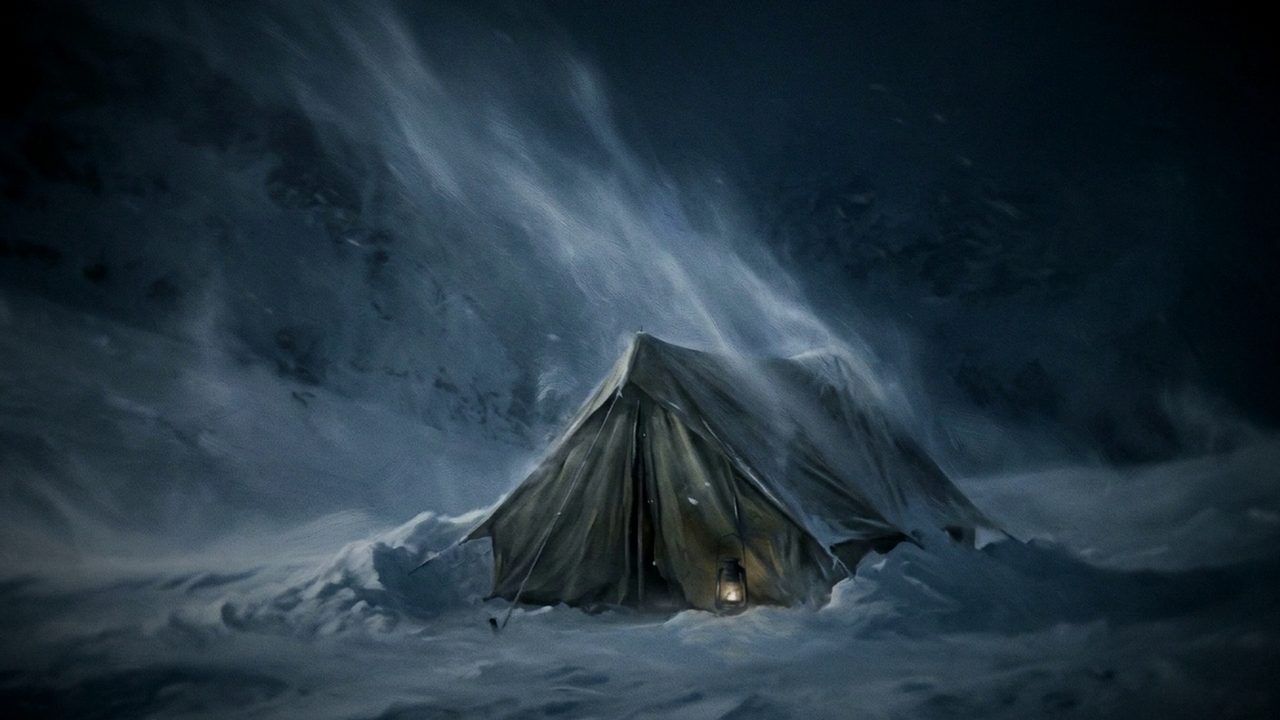
February, nineteen fifty-nine. High on an open slope in the northern Ural mountains, a single tent stands half-buried in snow. When searchers find it, three weeks later, every sleeping bag and boot and coat is still inside. The tent itself has been cut open. Not from the outside. From the inside. Below it, leading down into the dark and the cold, are tracks. Nine sets of them. Left by people who had, for reasons no one would understand for sixty years, walked out into a sub-zero night with almost nothing on.
This is the file on the Dyatlov Pass, a night in the northern Urals that became one of the most argued-over mysteries of the twentieth century. Someone tried very hard to make this one disappear. Let's open it before the ink fades.
Ten Who Went to the Mountain
Before this becomes a mystery, let it first be what it actually was. A trip. Ten young people — most of them students and recent graduates of the Ural Polytechnic Institute, in the Soviet city of Sverdlovsk — strapping on skis for a long winter traverse of the northern Urals. Not victims. Not a legend in the making. Friends, setting out in January cold with packs on their backs, doing the thing they loved most.
Their leader was a twenty-three-year-old named Igor Dyatlov. Calm, technically precise, the sort of person you follow into difficult mountains because you know he will get you home. The route would carry his name for the rest of history. He would not have wanted that. With him went eight others: Zinaida Kolmogorova, twenty-two years old. Lyudmila Dubinina, twenty. Yuri Doroshenko, twenty-one. Georgiy Krivonishchenko, twenty-three. Alexander Kolevatov, twenty-four. Rustem Slobodin, twenty-three. Nikolai Thibeaux-Brignolle, also twenty-three. And the oldest of the group by some distance: Semyon Zolotaryov, thirty-eight, a guide and veteran, considerably quieter than the students around him, carrying his own reasons for being there.
Then there was the tenth. A twenty-one-year-old named Yuri Yudin. He started out with them on the twenty-seventh of January. But early in the trek, an old injury in his joints flared, and on the twenty-eighth he made the sensible, deflating decision to turn back. He embraced his friends in the snow. He watched them go. He went home. That ordinary act of listening to his own body is the reason there is anyone left to tell you any of this. Yuri Yudin lived to ninety years old. He carried those eight names every day of it.
The plan was a fourteen-day ski tour rated Category Three — the highest difficulty classification in Soviet mountaineering. Their target was a mountain called Otorten, in the far north of the Urals. These were experienced, trained winter travellers. That matters a great deal. Whatever found them on the mountain, it did not find people who were careless or unprepared.
On the evening of the first of February, they made camp. Not in the treeline below, where the wind breaks and the temperature is survivable, but high up — on the open eastern flank of a mountain. The local Mansi people had a name for that mountain: Kholat Syakhl. It means Dead Mountain. The name is ancient, older by centuries than anything that happened there in nineteen fifty-nine. It is a topographical description, not a curse. But you can see, looking back, why the storytellers could not leave it alone.
The slope they chose was gentle. Fifteen to twenty degrees — almost nothing, by the standards of the sport. Hold that number. It is the single fact that would keep this case open for six decades, because a slope that shallow is not where you expect anything to slide.
They were roughly twenty kilometres from their goal. They dug the tent into the snow against the wind and settled in for an ordinary night. We have photographs from that afternoon. We have their diaries. The last entries are unremarkable — the jokes and small complaints of tired, cheerful people. Nothing in those pages knows what is coming.
At some point in the dark, between the first and the second of February, something happened in that tent. Something that made nine experienced winter travellers do the one thing every instinct and every ounce of training screams against. They cut their way out into the sub-zero night — and they left. What drove them out is the question that built a legend. And the legend is where we must begin.
The Legend the Silence Grew
You have very likely heard a version of this story. And the version you heard was probably the frightening one. So let us lay it out honestly — the full shape of the myth — because we cannot weigh the truth until we understand the darkness it had to cut through.
Three weeks after that night, on the twenty-sixth of February, a search party found the tent. Half-collapsed. Half-buried. Slashed open. And what they recovered over the following weeks and months was so strange, and so arranged by circumstance, that it seemed almost designed to resist a simple answer.
First. The tent had been cut open from the inside, and from the tent, nine sets of tracks led away downhill toward the treeline. Walking tracks, not a panicked scramble. Made by people in their socks. Some perhaps barefoot. Their boots were still in the tent. Their coats were still in the tent. In a place where bare skin begins to freeze within minutes, they had walked out voluntarily into the dark with almost nothing to protect them.
Second. About one and a half kilometres down the slope stood a single old cedar tree at the edge of the forest. Beneath it, a small fire had been lit and burned out. There, the first two of the group were found. The cold had taken them. And on the line back up toward the tent lay three more — among them Dyatlov himself — their faces turned uphill, as though they had been trying to crawl back to the shelter they had left.
The last four were found in May, when the snowmelt began. Not on the open slope, but in a ravine — in the bed of a stream, under several metres of hard-packed snow. These four had injuries the cold alone could not produce. Two had massive chest fractures — multiple broken ribs on both sides. One had a fractured skull. The forensic examiner who wrote the report reached for the only comparison that seemed to fit: a car crash. And yet — and this is the detail that lit the fire under every subsequent theory — there were almost no marks on the skin. No cuts over the broken bones. No bruising visible at the surface. The damage was entirely internal.
Now I want to step carefully here, because this is where the story has most often been unkind. One of those four — Lyudmila Dubinina — was found missing soft tissue from her face: her tongue, parts of her eyes. The legend called this mutilation. Called it evidence of murder, or of something worse. It was almost certainly neither. She had lain for roughly three months in running water, in a cold mountain stream. Soft tissue is what water and wildlife take first, and take fast. It is, in plain and respectful terms, what happens to a body left that long in such a place. It is not the signature of a killer. It is the signature of time, and cold water, and the patience of the wild.
But in nineteen fifty-nine, comfort mattered more than precision. And so the theories grew, each reaching further into the dark than the last. People in the area had reported strange lights in the sky around the same time — orange spheres, described as glowing, drifting without sound above the mountains. Unidentified. Floating. Watching. To a frightened public, those lights became a confession that something had descended from above for the nine on the slope.
Others looked toward the military. The Soviet Union was testing weapons in the Urals, that much was not in dispute. And the radiation only deepened the uncertainty. When some items of clothing were tested, they showed traces of radiation — a detail that arrived like a key fitting a very ominous lock. But I owe you the full record, not the dramatic excerpt. The radiation found was a single type — beta only. No alpha. No gamma. The levels were modest. And at least one member of the group, Krivonishchenko, had worked at a nuclear facility, which offers a more mundane path for the contamination. Is it perfectly explained? No. And I would rather tell you that plainly than pretend the file is tidier than it is.
There were theories about the Yeti — fuelled, it later emerged, by a joke photograph the group had staged themselves, as a prank. There were ancient curses attached to the name Dead Mountain. There were escaped criminals, and foreign agents, and stranger things still. And over all of it, like an official ceiling, hung a single phrase from the Soviet investigation.
When the inquiry closed in nineteen fifty-nine, it needed to write down a cause of death. The words it chose were these: that the group had perished due to an unknown compelling force. Read those words as what they are. They are not a finding. They are the space where a finding should be. A bureaucrat's careful way of writing — we looked, and we could not say. The public, however, did not read them as an empty box on a form. They read them as a clue. As if the Soviet state itself were admitting that something nameless and powerful lived on that mountain. That phrase kept this mystery alive for sixty years.
So that is the shape of the myth. Lights in the sky. Internal injuries with no wound. Radiation. Missing soft tissue. A force without a name. It is a powerful story. It is also, almost entirely, a story that the world chose over a quieter, more patient answer — one that had been waiting in the snow the whole time. To find it, we have to go back to the tent. And this time, we have to read the slope.
Reading the Snow
Put the monsters down. Go back up to that tent, and look at it the way a careful investigator would — one detail at a time, asking of each not "how frightening is this," but "what does this actually tell me." Because nearly every element of this so-called mystery, read without urgency, points the same quiet direction.
Start with the cut in the tent. For decades the image people carried was of something slashing inward — a blade from outside, a claw through the canvas. The forensic record is unambiguous. The cut was made from the inside. Nothing broke in. The nine cut their own way out. And experienced winter travellers do not knife open their only shelter in a sub-zero night for nothing. They do it when staying inside has, in an instant, become more dangerous than the cold waiting outside.
Next, the tracks down the slope. They walked. Not a blind, panicked scatter in every direction — a more or less ordered movement of eight or nine people, downhill, toward the treeline. Anyone familiar with mountain rescue knows what that movement means. It is not the behaviour of people fleeing a creature. It is the behaviour of people evacuating a dangerous slope — getting off exposed ground, heading for the shelter of the forest below, exactly as they had been trained. Whatever had frightened them out of the tent, they did not lose their discipline in the first minutes.
Now, the cedar and the fire. They reached the tree. The lower branches were broken — they had climbed it, probably to see back up to the tent, or to collect fuel. They lit a fire. These are not the actions of helpless victims. These are the actions of competent people doing precisely what you do in a survival situation.
And then the cold did what extreme cold does. Severe hypothermia, in its final stages, produces a phenomenon that is documented and named: paradoxical undressing. The dying body, in the last confusion of cold, generates a false sensation of heat. People remove their clothing. They cannot feel that they are cold. It is why some of the group were found with so little on. Not stripped by anyone. Removed by their own failing bodies, in the last moments of freezing.
The autopsies support this for the majority of the group. Most died of hypothermia. Not violence. Not radiation. Not a force without a name. The oldest enemy of anyone who goes high in winter — the cold, patient and indifferent, doing what it always does.
Which leaves the piece that resisted the simple reading for so long. The four in the ravine. The crushed ribs. The skull fracture. The car-crash force, applied from inside the body, leaving no mark on the skin. The cold cannot break a person's ribs from the inside. That much is true. But the cold, it turns out, was never working alone on that slope. Something else had moved in the dark, hours before anyone died. And to name it, science had to wait more than sixty years.
The Slab in the Dark
In twenty twenty-one, two scientists published a study that did, very quietly, what six decades of monster-hunting had failed to do. Johan Gaume, an avalanche specialist, and Alexander Puzrin, an engineer who studies how ground and snow fail under stress. And the question they asked themselves was the oldest objection in the entire case. The slope was too shallow to avalanche in the traditional sense. So how, on a fifteen-degree slope in the dark, could snow alone have broken ribs and fractured a skull without leaving a mark on the skin?
Their answer was not the great roaring avalanche of the imagination. It was something smaller, and in some ways more insidious. A slab.
When the group made camp on the evening of the first of February, they did what any competent party would do. They cut into the slope to make a level platform for the tent — carving a flat shelf out of the hillside, so the wind would not find them at an angle. Ordinary mountain practice. Entirely sensible. And entirely without their knowing it, that cut created a weak point in the snowpack above them.
Then the night came. And with it, a wind. Not just any wind — a katabatic wind, the kind particular to these high open slopes, where cold dense air pours downhill off the heights, carrying loose snow with it, hour after hour. That wind loaded snow onto the slope above the tent. The weight grew slowly, through the night, while nine people slept below. And the cut they had made was the flaw the weight was waiting for.
Hours after they had gone to sleep — not immediately, but later, when the loading had built past the threshold the cut had set — the slab let go. Not a mountainside. A single firm block of wind-compacted snow, perhaps the size and shape of a large table, sliding down onto the upper end of the tent. And here is where the geometry turns merciless. The group had done what mountaineers do — they had laid their skis flat beneath them, as a rigid floor between their sleeping bodies and the cold ground. A heavy slab driving a sleeping body down onto a surface as rigid as wood is precisely the kind of force that fractures ribs from the inside without cutting the skin above them. The car crash, as the forensic examiner called it. Explained. Not by a weapon, not by a beating. By a block of snow and a pair of skis.
And once you hold that, the rest of the file falls into order. The slab strikes in the dark. Some of the group absorb terrible injuries in their sleep. The tent is partially crushed — the way out blocked above them. So they cut through the canvas from the inside, and they bring the injured downhill, off the open slope that has just tried to kill them, toward the treeline — exactly as they were trained to. The fire. The cedar. The attempts to climb back up toward the tent. And then, on a night where the temperature falls to well below freezing and the wind does not stop, the cold takes what the snow began.
In twenty twenty, a year before the Gaume and Puzrin paper appeared, the Russian Prosecutor General's office had already quietly moved in this direction. An official review concluded that the cause was, in essence, an avalanche event combined with a sudden deterioration in the weather: a rapid exit from the tent, loss of direction in the dark, and death from cold. No rocket. No infrasound experiment. No earthquake. No creature. No force without a name. A later follow-up, in twenty twenty-two, confirmed that real avalanche activity does occur on these slopes.
Sit with that for a moment. Nine skilled, experienced, careful people. They camped correctly. They reacted to a crisis with discipline. They tried to keep each other alive, in the dark, on a slope that had just broken some of them. And the mountain killed them anyway. Not with anything that needed a name. With snow, and wind, and cold, and the particular cruelty of physics applied to sleeping bodies.
The Verdict
The last pages of this file are heavier than most. Before we reach the theories, one honesty owed to nine people: these are not monsters to be entertained. They are competing explanations for a real tragedy, and most of them were settled a long time ago.
Theory one: the snow slab — 55%
The reconstruction by Gaume and Puzrin — peer-reviewed, published, and mechanically tested against the specific conditions of that night. A gentle slope made lethal by a single cut for a tent platform, hours of katabatic wind loading fresh snow above it, and a slab releasing onto sleeping bodies pressed against a rigid surface of skis and ice. For it: it is the only theory that answers the complete file — the inside cut, the ordered retreat, the crushing injuries with no external wound, the delay between camping and disaster. Against it: definitive proof is impossible at sixty years' distance, and the radiation traces sit outside its direct scope.
Theory two: hypothermia and paradoxical undressing — 25%
Less a rival theory than the mechanism of most of the deaths — the cold's own method, working through the final hours. For it: it is written plainly in the autopsies of the majority, who died of exposure, not violence. Against it: it tells you how they died, not what drove them out of the tent to begin with.
Theory three: a katabatic storm — 8%
That a sudden violent downslope wind and a sharp turn in the weather were the primary trigger. For it: such winds are real on these slopes. Against it: a storm explains the conditions, but not the internal injuries — for those, you still need the slab.
Theory four: infrasound panic — 5%
Associated most closely with the writer Donnie Eichar — that wind curling around the dome of the mountain generated infrasound, which can induce profound unease and irrational flight. For it: it offers a mechanism for panic with no visible cause. Against it: speculative, extremely difficult to test, and the slab removes the need for an additional panic-trigger.
Theory five: a classic avalanche — 3%
The older idea that a large, conventional avalanche swept the camp. Against it: the slope is simply too shallow for a textbook avalanche — precisely why the slab model was developed and displaced it.
Theory six: a military test — 3%
That a secret weapon or a wayward rocket killed the group. Against it: the radiation was beta only, limited in extent, partly explained by one member's professional history, and the twenty-twenty review found that weapons tests would not even have been visible from the pass.
Theory seven: the supernatural — 1%
The orange UFOs, the Yeti, the ancient curse of Dead Mountain. Against it: the lights were most probably distant rocket tests or an optical effect, the Yeti was the group's own joke, and the name of the mountain predates the tragedy by generations.
So lay the cards down. The most likely truth about what happened at Dyatlov Pass is not a story with a monster in it. It is a story with no monster at all. And that, strangely, is the part the world found hardest to accept.
If you are asking me: the mountain needed no agent, no creature, no secret weapon. An unseen slab of snow. A cut in the slope made by nine people who could not know what they were weakening. A wind in the dark that loaded the trap. The cold did the rest. The cruelest thing about this story is its plainness. These nine were not chosen by anything. They were not targeted. They were simply there, on the wrong slope, on the wrong night, when the snow above them finally gave way.
For sixty years, an empty phrase on a Soviet form — an unknown compelling force — held this file open, and let every imagination fill the silence in its own way. In the end, what closed it was not a séance, and not a leak. It was a pair of scientists, sixty years of better mathematics, and the patience to ask the slope a question directly. The force was never unknown. We just had to be humble enough, and careful enough, to name it.
Nine names remain, that the legend tends to forget: Igor Dyatlov, and those who trusted him enough to follow him up a dead mountain. And Yuri Yudin, the tenth, who turned back with aching joints, outlived them all, and by every account never stopped thinking about them for the rest of his long life.