Episode 5
The Flannan Isles
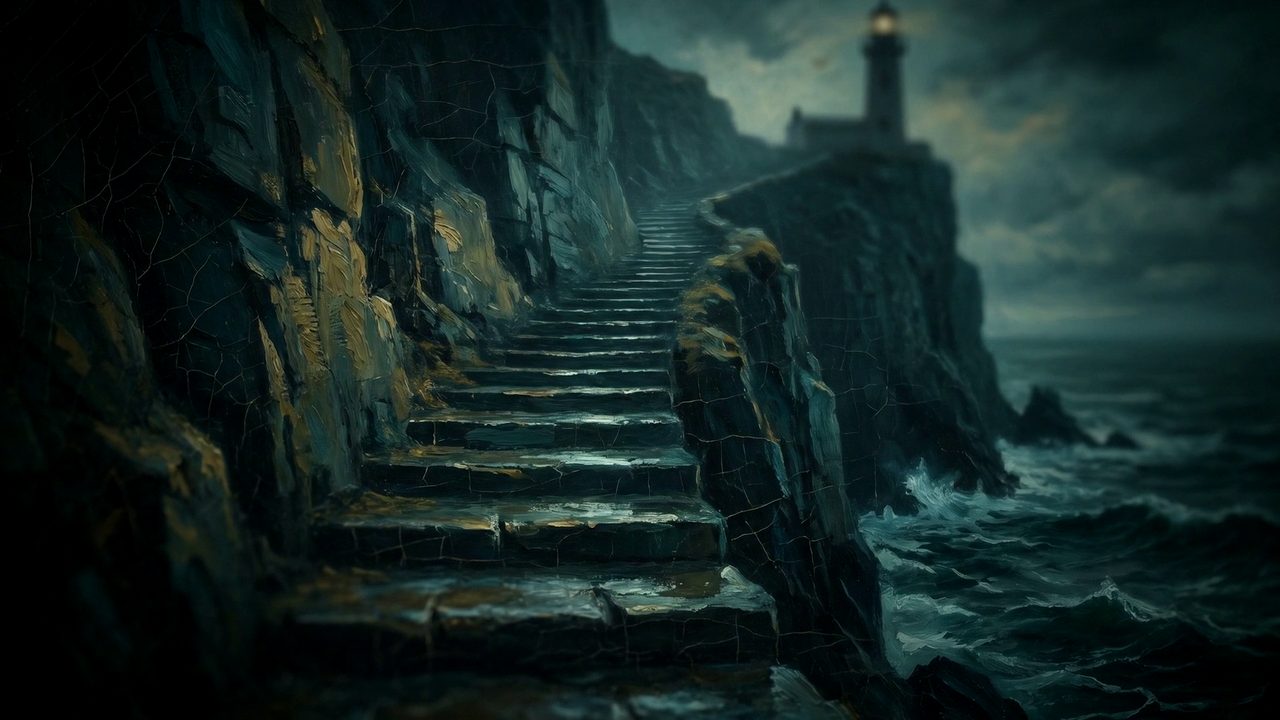
The water remembers what the world forgets.
The fifteenth of December, nineteen hundred. West of Scotland, a cargo steamer called the Archtor is clawing through heavy weather off Eilean Mòr. The new lighthouse should be burning by now. There should be a light. There is not.
This is the file on the lighthouse of Eilean Mòr, and the three men it swallowed. Salt has eaten half the margins of their story — let's open it before the ink fades entirely.
The Island No One Would Sleep On
You may think you already know this story. The meal left uneaten on the table. The chair tipped over. A canary, perhaps, still singing in its cage. Hold that picture. Hold it loosely. By the time this account closes, you will understand exactly where that picture came from — and it was not from the island. To read what happened properly, we have to start where every story starts: with the place itself.
Twenty miles — about thirty-two kilometres — west of the Isle of Lewis, the coastline of Scotland makes one last, half-hearted attempt at existence. Seven pieces of rock rise from the North Atlantic. Sailors named them the Seven Hunters. Who they were hunting, and what for, the name no longer says. The maps call them the Flannan Isles. The largest of them — and largest is a generous word — is Eilean Mòr. In Gaelic, the name means simply the big island. It is thirty-nine acres of thin grass and older stone, ringed on every side by cliffs that fall directly into deep water. There is no harbour. There is no beach. There are only two landing places cut into the living rock — one facing east, one west. The sea decides, on any given day, which of them may be used. On many days of the year, the sea decides neither.
People have known this island for a very long time, and for a very long time they have maintained a respectful distance. On the summit there is a small stone chapel dedicated to Saint Flannan, ruinous already by the time our story begins. Each summer the crofters of Lewis rowed out — to graze sheep on the thin grass, to gather seabirds' eggs — and then, before dark fell, they left. The rule of Eilean Mòr was not written anywhere. But it was not broken. We know this unusual detail because in seventeen oh three, a traveller named Martin Martin recorded exactly how Lewis men behaved when they came ashore here. They removed their hats. They walked the plateau in a slow turn sunwise — a small private acknowledgement of whatever the island considered itself the property of. And spending the night on the rock, he noted, was held to invite misfortune. A place of saints by day, the old people said. Something else's after dark.
None of this is folklore to laugh at. Rules that look like superstition on first reading more closely resemble sound risk assessment on the second: do not linger on a rock with no safe landing, do not be there when the weather shifts. Call it folklore if you like. It kept people alive for a thousand years.
Then came the nineteenth century, and the nineteenth century had little patience for arrangements it had not made itself. The seas around the Flannan Isles had been swallowing ships for as long as ships had used those lanes, so the Northern Lighthouse Board decided the Seven Hunters would carry a light. The contract went to the engineer George Lawson, and the work consumed nearly four years. Every block of stone, every lens, every barrel of paraffin oil had to come ashore from a pitching boat onto a rock with no harbour, then travel up a cliff-face the height of a cathedral. By any standard of the age, this was engineering's answer to geography. Geography tends to be the patient party.
On the seventh of December, eighteen ninety-nine, the lamp was lit for the first time: seventy-five feet — about twenty-three metres — of white tower, standing on a hundred and fifty feet of sheer cliff, a light visible for twenty nautical miles in clear conditions. The old unwritten rule of the island was not abolished. It was put on a salary. From now on, three men would live on Eilean Mòr at all times — through every night the Lewis fishermen had spent a thousand years carefully avoiding.
The lamp burned through its first winter without incident. Then came its second — December of nineteen hundred, barely twelve months into service. The Archtor looked for the light in a gale. And found only darkness. A lighthouse exists to make one promise — the light does not go out. When it does, the machine is not what has failed. The men are.
Three Men, One December
The principal keeper was James Ducat: a veteran of the lighthouse service, methodical, trusted, and a father. Ducat had not wanted the Flannan posting — this we know from inside his family. Decades after his disappearance, his daughter Anna recalled what he had said when the assignment came: the rock was too dangerous, he had told his wife, and he had four children depending on him. But a senior officer of the Board persuaded him. Keep that man's name to one side for now; he has a role to play before this account closes. Ducat went. Men of his character tended to — men who named a risk plainly, weighed it carefully, and carried it anyway.
The second keeper was Thomas Marshall, the assistant: younger, capable, steadfast by all accounts. The third man that December was not originally scheduled to be there at all. Donald MacArthur was a substitute — an occasional keeper covering for a regular who was ashore. He was a local, and the personnel files remember one further thing about him: a temper. Not a crime, not a formal charge — just a temper, observed and noted. Keep hold of that detail; it will reappear before this account is done, wearing rather darker clothes.
Life on Eilean Mòr was organised around routine, because routine is the tool a man uses to stay sane on thirty-nine acres of rock. Trim the wicks. Polish the lens. Haul the oil up from the stores. Watch the weather and write it down. At dusk, light the lamp. One regulation stood above all others: the lamp is never left unwatched. Whatever happens outside, one man stays.
There was no radio, no cable. News left the island at the speed of a supply vessel, and the supply vessel came at the pleasure of the Atlantic — which in December is rarely generous. The relief tender, the Hesperus, was due at the Flannans around the twentieth of December. The weather had other intentions.
What do the records actually tell us about the last days of Ducat, Marshall, and MacArthur? Less than you have probably been told — and precisely that is what makes what they do tell worth attending to. The weather slate beside the lamp carries entries in the usual hand, running to the morning of the fifteenth of December. Around nine o'clock that morning the record stops. The lamp had been cleaned, the oil reservoirs filled — everything stood ready for the night. Whatever reached these men, it reached them in the middle of an ordinary, orderly working morning. The day simply ends, mid-sentence, without a full stop. That same night the Archtor passed in the storm and found no light.
The days that followed brought foul weather, and the relief kept being postponed. The twentieth came and went. Christmas came and went. On the twenty-sixth of December — Boxing Day — the wind finally eased. The Hesperus, under Captain Jim Harvie, dropped anchor off the island at midday. Harvie sounded the steam whistle, the standard signal that brought keepers down to the landing. No one appeared. No flag on the flagstaff, no provision boxes, no figure anywhere on the rock. The island sat in the winter light — complete, silent, and closed.
A boat was lowered. One man went ashore and climbed the path to the lighthouse alone: Joseph Moore, himself a Flannan keeper returning from shore leave to a station he knew as well as his own kitchen. What Moore found in the following half-hour would supply a century of ghost stories. What he did not find is the richer mystery — and almost no retelling begins there.
The Empty House
Think of the climb. The steps up from the east landing, the path rising toward the lighthouse on the summit — walked a hundred times, but never before toward a tower that had been dark for eleven nights. The gate in the perimeter wall: closed. The entrance door: closed. He opened them and stepped into a hallway that held the specific quality of silence a house only acquires when it has been keeping it for days. He called out. Nothing answered.
The kitchen was clean and orderly, the ashes in the grate cold. The clock on the wall had stopped, wound by no one for too long. In the sleeping quarters, three beds stood empty. And up in the light room, the great lamp waited cleaned, filled, and ready to be struck. The machine was in perfect order. Its keepers were gone. All three of them.
Moore checked the row of hooks by the door where oilskins hung — the heavy waterproofs no rational man stepped outdoors without in a Hebridean December. Two sets were missing: Ducat's and Marshall's. But the third set, Donald MacArthur's, hung on its hook. Whatever had summoned MacArthur out of that house had summoned him into the weather in his shirtsleeves — loudly enough, urgently enough, that he had not paused to take his coat. And yet the door behind him had been pulled shut.
Moore came back down the path in considerable distress. He returned with seamen from the Hesperus, and together they walked Eilean Mòr from end to end: thirty-nine acres, three missing men, no one found — living or dead. Captain Harvie sent a telegram to the mainland; you can hear the helplessness in its grammar. The poor fellows, he wired, must have been blown over the cliffs or drowned. Moore remained on the rock — someone had to maintain the light — and relit the lamp that same evening.
Here is where the famous version of this story would like to take over. You know the scene: a table laid for a meal, meat and potatoes, a cup of cold tea, a chair knocked onto its back, sometimes even a canary. It is one of the great images of popular mystery — the half-eaten meal of Eilean Mòr. It is not in the record. None of it.
Moore — the one man who opened that door first — reported a tidy kitchen and a house in order. No meal. No overturned chair. No canary. So where did the scene come from? A poem. In nineteen twelve, twelve years after the disappearance, an English poet named Wilfrid Wilson Gibson published a ballad entitled Flannan Isle. The set table, the untouched food, the fallen chair — Gibson invented them, as poets are fully permitted to do. The poem was widely read, and gradually, image by image, it settled back into the historical record. Newspapers repeated its details as established fact. The poem did not describe the mystery. The poem wrote it.
And the poem is not the only invention in circulation. You may also have heard of the log entries — Marshall writing of seas the like of which he had never seen in twenty years; Ducat silent; MacArthur, the toughest of the three, weeping; and on the last morning, the line: God is over all. Devastating. Famous. And almost certainly fabricated — the conclusion of modern researchers, most thoroughly Mike Dash, who worked through the archives in the nineteen nineties. These entries appear in no contemporary record; they surface decades later, in sensational magazine articles, a little smoother with each retelling. Good stories travel faster than true ones. They pack lighter. Strip the poem away, set the invented log aside, and read only what the investigators actually wrote down. Because the actual file contains something stranger than any overturned chair. It contains a coat on a hook — and a landing platform that looked as though the sea had reached up and tried to take the island apart stone by stone.
The Superintendent's Ledger
Within days of the discovery, the Northern Lighthouse Board dispatched its superintendent to the rock: Robert Muirhead. For him this was not a routine matter. In the report he signed and filed, Muirhead permitted himself a plain admission of closeness — he had known Ducat and Marshall intimately, and MacArthur too; they had been selected on his recommendation. The investigator had recommended the victims. And in the document's margins sits a darker note still: the senior officer who had once persuaded a reluctant James Ducat to accept this posting — the man his daughter named, years later — was Muirhead himself. He had sent Ducat to the rock. Now he came to find out what the rock had done with him.
What Muirhead conducted across the final days of December was a methodical, unsentimental investigation. He questioned Joseph Moore, examined the dwelling, the light room, the weather slate, the logbook, and measured what the sea had done. His report is dated the eighth of January, nineteen oh one, and it is the nearest thing this case possesses to solid ground.
Muirhead examined both landing places. The east landing: undamaged, untouched. Then he walked to the western side. The west landing had been devastated. Iron railings set into concrete had been bent flat and torn from their foundations. Ropes belonging to the landing crane lay strewn across the rocks. A block of stone weighing the better part of a tonne had been shifted entirely out of position. And then the detail that settles every argument about how high the sea can reach: a wooden supply box, wedged into a crevice one hundred and ten feet above sea level, had been smashed open, its contents scattered across the cliff below. The equivalent of a ten-storey building of water had stood against that cliff and broken over it.
From this physical evidence Muirhead built his reconstruction. On the afternoon of the fifteenth, he reasoned, Ducat and Marshall had gone down to the west landing to secure the crane against the worsening storm — which explains the two missing sets of oilskins and the scattered ropes. Then the sea produced something no ordinary storm warning could have described, and took them both. Which leaves the third man. Donald MacArthur, whose oilskins never moved from their hook, should by regulation have been indoors, beside the lamp. Muirhead's reconstruction — and it can only ever be a reconstruction — is that MacArthur saw something: a wall of water climbing the gully, his colleagues in difficulty below. Something sufficient to make a disciplined keeper break the one unbreakable rule and run out without his coat. He ran toward the west landing. The sea was not yet finished.
The report's conclusion is a single sentence of bureaucratic precision: the three men had been swept away by an exceptional sea while engaged in work, or attempting a rescue, at the west landing. Case closed. Accident. No bodies were ever recovered. The ocean west of the Hebrides does not, as a rule, issue documentation.
But the report does not end where a bureaucratic document would. It ends as a private confession. Muirhead had visited the Flannans on the seventh of December — one year to the day since the lamp was first lit, eight days before the weather slate fell silent. He had stood with all three men on that rock and shaken their hands when he left. In the report's closing lines he allows himself one sentence no regulation required: the melancholy recollection that he was the last person to shake their hands and bid them goodbye. The man who had sent Ducat to Eilean Mòr was also the last man from the outside world to touch him. For the families there was no mystery to contemplate — only the arithmetic of grief. Ducat left a widow and four children. The light, of course, kept burning. Lighthouses are extraordinarily good at continuing. It is one of the things people find most difficult to forgive them for.
And yet — read Muirhead's report a second time and you will notice what it moves quietly around. The damage at the west landing is genuine and extraordinary, but no witness can place it in the specific hours the men were lost; it could have accumulated in storms before or after. The reconstruction of MacArthur's final minutes is humane and coherent. It is also entirely without witness. The report demonstrates how three men could have vanished. It cannot demonstrate that they vanished in precisely that way.
The Verdict
The last pages of this file are left blank — for the verdict. Let's weigh what we know.
Theory one: the rogue wave — 55%
Muirhead's verdict, in essence. Ducat and Marshall at the west landing, tending the crane gear ahead of dirty weather; MacArthur drawn out by whatever happened next. The strongest evidence stands one hundred and ten feet above the sea: a smashed supply box no ordinary swell could have reached. Against it: the wave alone does not explain the coat. A keeper stationed indoors with the lamp is not swept off a landing stage. Something still had to bring MacArthur out of the house.
Theory two: the chain of rescue — 30%
A refinement, and a harder one. Two men go down to work the landing; one is taken. The other tries to hold him. MacArthur, watching from above, abandons everything — the lamp, his coat, the regulation — and runs. The sea takes the rescuers in sequence. For it: the only straightforward account that makes sense of every object in the house. Against it: pure inference. Not one link in that chain has a witness.
Theory three: the quarrel — 10%
Three men, thirty-nine acres, a relief long overdue, and one of the three with a temper that had made the official file. The dark version writes itself. For it: the isolation was genuine, and MacArthur's temper is in the record. Against it: everything else in the record. Muirhead found nothing — no disorder, no sign of struggle. A theory that requires the absence of evidence to function is already working too hard.
Theory four: the island itself — 5%
The oldest entry on this shelf — the debt of Eilean Mòr, collected at last. For it, honestly, nothing that can be weighed. But the folklore itself is real history: Martin Martin wrote down the islanders' dread two centuries before the keepers vanished. That is atmosphere worth preserving. It is not evidence. Phantoms, in long experience, keep very poor documentation.
And there remains the page we cannot find. What actually happened in the hours after nine o'clock on the morning of the fifteenth of December? Between the last chalk entry and the moment the Archtor found only darkness, there is nothing but silence. No theory fills that silence; they can only stand around it, holding their lanterns.
If you ask me — and you did, you opened this file — the sea wrote this one. The west landing reads like its signature. But the sea left the third coat entirely unexplained, and a poet arrived to fill the silence, and history has been paying for that ever since. That, I'm afraid, is how a legend is built. Not from what was found. From what could not be.
Three names remain: James Ducat. Thomas Marshall. Donald MacArthur. The light they tended still burns on that rock — automated now, tended by no one, watching the same water. History rarely closes its books. It simply stops writing for a while.