Episode 1
The Mary Celeste
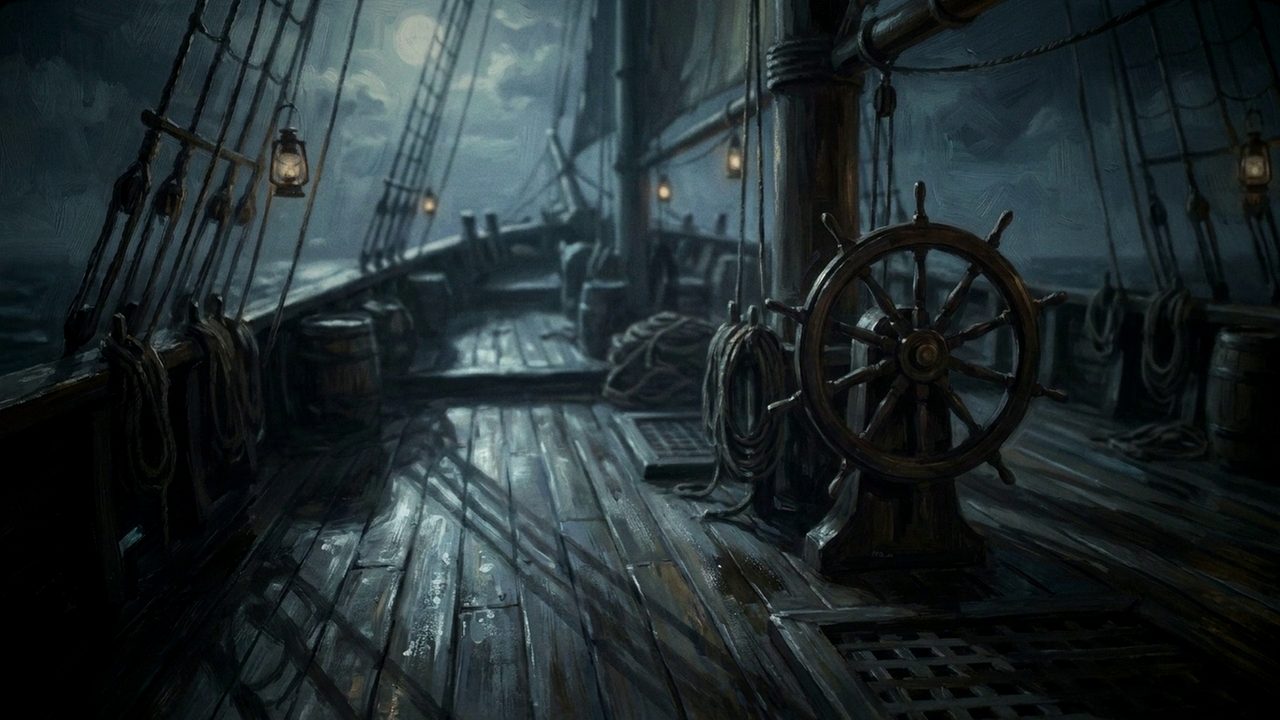
The water remembers what the world forgets.
December the fourth, eighteen seventy-two. The Atlantic, roughly five hundred miles west of Gibraltar, under a grey and indifferent sky. A brigantine is making way under half her sails. She holds her course. She does not wander. And there is no one at the wheel.
Her cargo is intact. Her stores are full. Her lifeboat is gone. And every one of the ten people who sailed her out of New York — the captain, his wife, their two-year-old daughter, and seven men who knew the sea — have vanished into calm weather, without a body left behind and without a word of explanation anywhere aboard.
This is the file on the Mary Celeste — the most famous ghost ship ever to sail, and the most thoroughly misremembered. Someone has written a wrong name across her cover in a very confident hand. Let's deal with that, and open the file properly, before the ink fades.
The Wrong Name on the Right Ship
You already know this ship. You are almost certain of it. You can picture it now: the breakfast things on the cabin table, still laid, the coffee still steaming in the cold. A child's toy where it fell. A page in the ship's log ending mid-sentence. The lifeboats still hanging in their davits — no one chose to go. A ship sailing herself through an empty sea, every soul aboard taken between one heartbeat and the next, the way a candle goes out in a sealed room.
It is one of the great images of the sea. And it is almost entirely the invention of a twenty-four-year-old doctor who was not there.
Nearly everything the world believes about the Mary Celeste was written by a man twelve years too late and an ocean away, working entirely from imagination. To read what actually happened, we have to put down his story first and pick up the court file. Because the true case is stranger than steaming coffee — and considerably sadder.
But let us begin at the beginning: with a ship, and a name, and a history of bad luck that may or may not be more than coincidence.
She was built in eighteen sixty-one, on Spencer's Island in Nova Scotia, by a man named Joshua Dewis. A brigantine — two masts, square-rigged forward, fore-and-aft on the main — a working merchant vessel of the kind the Atlantic knew well. And her first name was not Mary Celeste. Her first name was the Amazon. Under that name, the records around her early years are thin and grim in the way that sailors notice. What the record does say is that she changed hands, changed continents, and changed her name in December of eighteen sixty-eight. American owners registered her in New York, under the flag of the United States, and christened her Mary Celeste. Two words. Note them. A famous man is about to get them wrong, and the world is going to follow him for a hundred and fifty years. By eighteen seventy-two she had been rebuilt and enlarged — one hundred and three feet, roughly thirty-one metres of hull, two hundred and eighty-two gross tons, a second deck added. A sound and freshly overhauled working ship. Not a haunted thing. An asset.
Now: the story that buried the truth. In January of eighteen eighty-four — twelve years after the ship was found empty — a short piece of fiction appeared anonymously in an English publication called the Cornhill Magazine. Its title was "J. Habakuk Jephson's Statement." Its author was a struggling doctor, four years away from giving the world Sherlock Holmes: Arthur Conan Doyle. Doyle was writing fiction, and he never claimed otherwise. But he was the particular kind of gifted liar that the best storytellers are, and his invention travelled like a virus through a world that had no immunity to it. He took the bare bones of a real abandoned ship and dressed them in detail: the warm meals, the running grease on the stove, the boats still lashed in place. All of it: invented. Not misremembered. Invented.
And he made one small change that outlasted everything else. In Doyle's story, the ship is not called the Mary Celeste. She is called the "Marie Celeste" — the French spelling, a slip of the pen or a deliberate flourish. It was a small error in a piece of fiction by a young man at the start of his career. It is, to this day, the name most people use for a ship that was never called that.
When you cannot tell the true story from the legend, follow the court. The court in this case sat in Gibraltar, in the winter of eighteen seventy-two, and it preserved more than it intended to. Let us go there. But first, let us count the people aboard, because they have been forgotten in almost every telling, and that is the real crime this file records.
Ten Souls and Seventeen Hundred Barrels
Ten people sailed on the Mary Celeste when she left New York on the fifth of November, eighteen seventy-two. Not a faceless crew. A household, and the men who worked the ship around it.
Captain Benjamin Spooner Briggs was thirty-seven years old, born into a family of sea captains in Massachusetts, and by every account a man of discipline and faith. He did not drink. This is not a passing detail. He was, in the language of the day, a temperance man. And he was about to spend several weeks at sea in command of a ship carrying one thousand seven hundred and one barrels of it. He was also not merely the master of the Mary Celeste. He was part-owner. His own money was in her timbers. Keep that fact somewhere safe. He did not sail alone. He brought his wife, Sarah, and their daughter, Sophia Matilda, who was not yet two years old. There was a son — Arthur, seven — but the boy was left ashore to keep up his schooling. One child sailed. One child waited at home.
The crew were seven. First mate Albert Richardson — experienced, known to Briggs, trusted. Second mate Andrew Gilling. Steward and cook Edward Head. And four able seamen: the brothers Volkert and Boz Lorenzen, German; Arian Martens and Gottlieb Goudschaal, Frisian. Foreign-born, all of them. This matters, because when the darker theories begin to circulate, someone will point at the foreign names and whisper the word mutiny. Before he sailed, Briggs wrote of his crew in a letter — called them peaceable, and first-class sailors. The men who invented the murder plot never met them.
Now the cargo. In her hold, the Mary Celeste carried one thousand seven hundred and one barrels of alcohol. Not drinking alcohol — industrial alcohol, denatured, poisoned by design, undrinkable and toxic to consume. It was bound for Genoa, for a firm named Mascarenhas, and it was highly flammable. The ship and her cargo together were insured for somewhere near forty-six thousand dollars. The first dark theory anyone reaches for, when they hear that a ship's crew vanished from a hold full of alcohol, is that the men broke into the barrels, got drunk, and ran wild. They could not have. A man who consumed this cargo would not become intoxicated. He would become ill. Or he would die. The poison in those barrels threatened these people in another way entirely. We are coming to it.
The Mary Celeste left New York from Pier Fifty on the fifth of November. Five days behind her, another ship was made ready: a brigantine called the Dei Gratia, under Captain David Morehouse, first mate Oliver Deveau. Keep her just over the horizon. She is going to be the only witness this entire case ever gets.
The last entry on the Mary Celeste's log slate is dated the twenty-fifth of November, at eight in the morning. Position: near the island of Santa Maria, in the Azores. Up to that mark, everything is ordinary — the dull, reassuring handwriting of a voyage going to plan. And then the slate goes quiet. Whatever happened to the Mary Celeste, it happened after eight o'clock that morning. The ship herself never wrote another word about it.
Ten people. One family. Seven sailors. A captain who would not touch strong drink, commanding a hold full of poison in the dark below his daughter's feet. Nine days later, a man on another ship raised a glass to the horizon — and saw something that made no sense.
What Deveau Found
The Dei Gratia was running roughly four hundred to six hundred miles west of Gibraltar when her crew sighted a sail that was not behaving as sails should. A brigantine under reduced canvas, yawing — drifting off course and correcting, the slow, purposeless wandering of a ship that has no one at the helm.
Captain Morehouse held off, watched, and signalled. Nothing answered. So he sent a boat across. The man he sent was his first mate, Oliver Deveau. Everything we can reliably say about the condition of the Mary Celeste rests on what Oliver Deveau saw that morning, and what he later swore to in a Gibraltar court of law. He is the only witness we have. He is also, notably, an excellent one.
Go aboard with him. The boat bumps her hull. The deck above is silent. Deveau comes over the rail onto a ship that is sailing herself and answering to no one. He calls out. Nothing answers.
Here is what he found. Lay it out plainly, because every theory the verdict weighs must answer to these objects. They are the real case. They are what Arthur Conan Doyle never read.
First — the ship was seaworthy. Sound hull, well-founded, no taking-on of water that the pumps could not address. Below, the stores were nearly full: six months of food and water still aboard. The cargo of alcohol was, with one exception, intact. Whatever drove these ten people off this ship, it was not the ship dying under them. By every physical measure, the Mary Celeste was a more survivable place than an open boat on the North Atlantic. And yet they had taken the open boat.
Second — the lifeboat was gone. The single small boat the Mary Celeste carried — a yawl — was missing from its place. Not torn away. Gone deliberately. The evidence described a rope cast off by human hands, a section of rail cleared to let the boat down. No wave swept these people overboard. They climbed down into that boat themselves. They chose to leave a sound ship for a small one. Which means that at some moment, in some condition of fear, leaving felt more survivable than staying. That is the hinge of the entire case. Remember it.
Third — the water. About three and a half feet of water had collected in the hold. It was a large amount of water, and far short of sufficient to sink a seaworthy vessel. The pumps still worked. But one of the pumps had been disassembled, and lying out on the open deck was the sounding rod — the simple weighted stick a crew uses to measure how deeply the bilge water stands. Someone, very recently, had been asking the ship an urgent question: how bad is it? And had left the answer half-taken on the deck when something interrupted them.
Fourth — the hatches. The main hatch was closed and secure. But the forward hatch and the small lazarette hatch toward the stern were open, their covers lying face-down on the deck beside them. You do not leave a hatch open at sea without reason. Open hatches on a working ship mean either that someone went below in sudden urgency — or that someone needed air to move through the hold very quickly.
Fifth — the instruments. The chronometer, the sextant, the navigation book, and most of the ship's papers were gone. These are not things a panicking man seizes at random. These are the precise tools you take when you intend to navigate — when you mean to find your way somewhere in a small boat, to make landfall, and survive. Whoever left the Mary Celeste did not flee in blind terror. They left like sailors. The logbook, interestingly, was largely left behind.
Sixth — the heartbreak. Everything personal stayed. The crew's pipes. Sewing materials. And in the family cabin, the small ordinary things of a life with a two-year-old child. No one packed a bag. No one gathered keepsakes. People who intend to abandon a ship for good take their treasures. People who expect to be back within the hour take their instruments and leave their wedding rings where they are. The cabin of the Mary Celeste was the cabin of people who fully intended to return.
There was minor damage, too. The binnacle — the housing that holds and protects the compass — had been knocked from its mounting, its glass cracked. Some sails were set and some were lost. A ship that had been through weather, and through something. But not a ship that had been wrecked. Not a ship that had been fought over.
Here is where the legend tries once more to climb over the rail. You have perhaps heard of the bloodstains — dark marks on the deck, on the forward rail, possibly a sword in the captain's cabin. The story demands blood. There was no blood. The dark stains on the deck were examined. They were rust — the kind that accumulates on any working ship in salt air. Not one inspector, not one surveyor, not one member of the Vice-Admiralty Court at Gibraltar found a single piece of evidence that violence had been done to any soul aboard the Mary Celeste.
So set the file on the table and look at it whole. A sound ship, full stores, a lifeboat gone by human choice. Water in the hold — frightening but manageable. A pump in pieces and a sounding rod dropped mid-reading. Two hatches thrown open over a hold full of volatile cargo. Navigation instruments taken; pipes and toys and wedding rings left behind. No blood anywhere. No struggle. This is not the scene of a vanishing. It is the scene of a decision. A fast decision, a frightened one, made by experienced sailors who expected to be back before dark.
The Court at Gibraltar
The Dei Gratia could not simply sail the Mary Celeste to port and consider the matter settled. Under the law of the sea, a vessel found abandoned and brought in by another crew is salvage — and salvage requires a court to establish that the finders came by her honestly, and to fix what they are owed. So Morehouse placed a prize crew aboard the Mary Celeste and brought both ships to Gibraltar. There, in December of eighteen seventy-two, the Vice-Admiralty Court sat to weigh the matter. This hearing is the reason we know anything at all.
The presiding judge was Sir James Cochrane. The man appointed to survey the ship was a surveyor named John Austin. And the official who drove the proceedings — the Attorney General for Gibraltar — was a gentleman by the name of Frederick Solly-Flood. Hold that name. Solly-Flood is about to become the file's most useful villain and its most accidental hero.
Solly-Flood did not see a tragedy when he looked at the Mary Celeste. He saw a crime. A ship in good order, cargo largely intact, not a corpse aboard — to his eye, this smelled of collusion. Murder. Mutiny. Perhaps a scheme between the two captains to defraud the insurers. He suspected nearly everyone and investigated with the methodical energy of a man who has already reached his conclusion.
And here is the irony worth savouring. Solly-Flood was wrong about almost everything — and his wrongness is precisely why the evidence survives. Because he was hunting for a crime, the ship was examined in extraordinary detail. The deck was inspected plank by plank. The dark stains were scientifically tested and found to be rust. Deveau was put under oath and made to describe, in granular, reluctant detail, precisely what he had seen. A man who was certain of murder cross-examined a man who was certain of accident — and between the two of them, they preserved the only reliable account we have of the state of the ship when she was found.
What did all that examination produce? No blood. No bodies. No sign of a struggle. The cargo nearly whole. The stores intact. The personal effects undisturbed. Every test Solly-Flood ran in pursuit of a crime came back empty. There was nothing on the cabin table. No abandoned breakfast. No warm cups. The court found the cupboard bare in exactly the place the legend would later set a feast.
In the end, no crime could be proven. The court awarded the salvors their money — a notably small share of the ship's value, a sum that whispered of lingering suspicion rather than a clean acquittal. The Mary Celeste was returned to her owners. No charge was ever brought. No murderer was ever named.
And Solly-Flood has one more scene. Years later, when Doyle's fiction had spread across the English-speaking world and hardened into fact, the old proctor read it. And he was furious. He wrote, in plain language, that Doyle's account was a fabrication from beginning to end. The man who once accused the real survivors of murder lived long enough to denounce the fictional version that erased them.
The court closed without an answer. No mutiny held together. No conspiracy bore the weight. The two captains who supposedly conspired had a motive too thin to carry a crime — a small salvage fee, weighed against the certain ruin of a part-owner who had put his wife and daughter in the ship's cabin. A man does not stake his two-year-old daughter against an insurance payout.
And yet, somewhere in that bare courtroom record, the answer was already lying in plain sight. Not in a crime. In a frightened reading of a gauge, and two open hatches, and something in the hold that no one drank, but everyone had reason to fear. The mystery was never the missing people. The mystery was why ten sensible, experienced sailors would ever choose an open boat over a sound ship, in calm weather, with six months of food below their feet — and cut themselves loose from safety.
The Verdict
The last pages of this file are left blank — for the verdict. The strongest reading of this case is not a single clean answer. It is a sequence: a trigger, then fear, then an orderly choice, then one piece of fatal bad luck.
Theory one: the alcohol fumes — 45%
Of the one thousand seven hundred and one barrels in the hold, exactly nine were found empty. Nine barrels of red oak, a porous wood prone to seeping. On this reading, somewhere between the twenty-fifth of November and the fourth of December, the crew smelled it, or heard it — a sudden venting, a bang of pressure. Captain Briggs, with his wife and daughter aboard, made the careful decision and the fatal one simultaneously: he threw open the hatches to clear the gas, and ordered everyone into the yawl, tied to the ship on a long line, to stand off at a safe distance until the danger passed. And then the line parted. A chemist named Andrea Sella, at University College London, reconstructed this scenario and found that venting alcohol fumes can produce what he called a cool flame — a flash with a loud report and a shove of pressure, violent enough to blow open a hatch, yet leaving almost no scorching. It explains the open hatches, the nine empty barrels, the instruments taken for a temporary wait, and a sound ship sailing herself away from people who chose to leave her for twenty minutes and never got back aboard.
Theory two: the false reading — 20%
A refinement of the first, and it may be where the fear began. The pump was in pieces and the sounding rod was lying on the deck. A crew trying to measure the water, with a compromised pump and a frightening false result, could have believed the ship was sinking far faster than she truly was. On its own, this does not explain the open hatches as cleanly as theory one — which is why it usually walks arm-in-arm with it, as the fear that preceded the decision.
Theory three: the sea itself — 18%
The Azores are seismically active. A seaquake, or a waterspout, could have been the jolt that set everything in motion. The geology is real and the timing fits. But the sea keeps no minutes of its proceedings, and what cannot be evidenced cannot be proved.
Theory four: weather, and a captain who chose wrong — 9%
Heavy weather, a frightened crew, and a master who misjudged a survivable situation. Against it: experienced sailors do not leave a well-found ship for an open boat in conditions the ship could ride out. The Mary Celeste was the safer option by any seamanlike calculation.
Theory five: the fraud — 4%
That Briggs and Morehouse, who knew each other, arranged the whole thing and split the salvage. Against it: everything. The salvage award was modest, hardly the fortune needed to justify destroying one's own investment and reputation — and Briggs had put his wife and daughter aboard.
Theory six: murder, mutiny, and the uncanny — 4%
The pirates, the mad foreign sailors, the hand from the deep. Against it: the file, entirely. The dark stains were rust, not blood. The alcohol was denatured and toxic — no drunk mutiny was chemically possible. The cargo was untouched; no pirate takes the people and leaves the goods.
Lay it down, then. The most likely Mary Celeste is not a ghost story at all. It is ten frightened, professional people on a sound ship, making a reasonable decision in an unreasonable moment, that happened to be the last decision they ever made. A trigger from the hold or from the sea itself. A captain who would not gamble with his daughter. An orderly retreat into a small boat, tied to the ship by a rope, to wait at a safe distance until the danger cleared. And then a wind. And a single rope, under tension, running out to its end. And a ship that sailed away without them.
If you ask me: the ship was never the mystery. The instruments were taken for navigation. The hatches were opened for ventilation. The water was measured because someone needed to know. Every object on that deck is the signature of people thinking clearly under pressure, people who intended to be back aboard by suppertime. They did everything that experienced sailors do. And then a rope, and the wind, did the one thing that no amount of seamanship could undo.
The cruellest line in this file is the last one. The most famous ghost ship in the history of the sea was almost certainly not haunted. Not cursed. Not the scene of a murder. It was a tragedy of arithmetic — a frightened, sensible miscalculation, in the middle of the Atlantic, on a morning when the maths came out wrong by the width of a rope. And a hundred and fifty years of legend — the steaming coffee, the breakfast laid for ten, the wrong French name — all of it the work of a young doctor who turned a grief into a story, and a world that preferred the story to the grief.
Ten names on the last page: Benjamin Briggs. Sarah. Little Sophia Matilda, who was not yet two. Albert Richardson. Andrew Gilling. Edward Head. The brothers Lorenzen. Arian Martens. Gottlieb Goudschaal. No graves. No bodies. The Atlantic, west of the Azores, does not as a general rule issue receipts.
The ship herself went on. In January of eighteen eighty-five, a captain named Gilman Parker ran her deliberately onto the rocks of the Rochelois Reef off Haiti, intending to cheat her insurers. He was caught. He was charged. The ghost ship the world had feared for a decade was finally destroyed — not by any phantom, but by precisely the kind of grubby little fraud that the court at Gibraltar had wrongly suspected thirteen years before.