Episode 4
The Princes in the Tower
The water remembers what the world forgets.
Spring, fourteen eighty-three. Two boys stand at a high window in the Tower of London. Brothers. One twelve years old. One nine. The elder is, technically, the King of England. By autumn, the window is dark. No funeral. No confession. No grave anyone has ever been able to name. They are simply — gone.
This is the file on the Princes in the Tower — two royal children who vanished at the heart of a kingdom and never came out again. Someone tried very hard to write the ending of this story for us. Let's separate that from what is actually documented, before the ink fades.
Two Boys and a Crown
Before this becomes a mystery, let it be what it actually was. Two brothers. Not pawns. Not symbols. Two children.
The elder was Edward — born the second of November, fourteen seventy. The younger was Richard, Duke of York, born the seventeenth of August, fourteen seventy-three. In the spring of fourteen eighty-three, Edward was twelve years old. Richard was nine. Hold those numbers. The legend that has grown around them is so crowded with crowns and daggers that it tends to forget the one fact that sits beneath everything else — that these were very small boys in the middle of an enormous game.
Their father was King Edward the Fourth. On the ninth of April, fourteen eighty-three, he died — unexpectedly, at roughly forty years old. In that moment, the elder boy became King Edward the Fifth of England. Twelve years old, and the weight of a kingdom waiting to fall on him. A child king is not powerful. He is simply the shape that power needs to fill — and filling it, for someone, is where the danger always lies.
The man who stepped forward was the boy's uncle. Richard, Duke of Gloucester — the dead king's younger brother. Parliament named him Lord Protector: guardian of the boy king, steward of the throne until Edward was old enough to hold it himself. On paper, the natural arrangement. The loyal uncle, minding the estate. Whether it stayed that way is the question this entire file turns on.
It moved quickly. On the thirtieth of April, young Edward was being escorted toward London for his coronation when his uncle intercepted the party at a place called Stony Stratford. The men riding with the boy — Earl Rivers, his half-brother Richard Grey, figures from his mother's family — were arrested on the road. One by one, the boy's people were peeled away from him. And he rode on into London under his uncle's guard, without them.
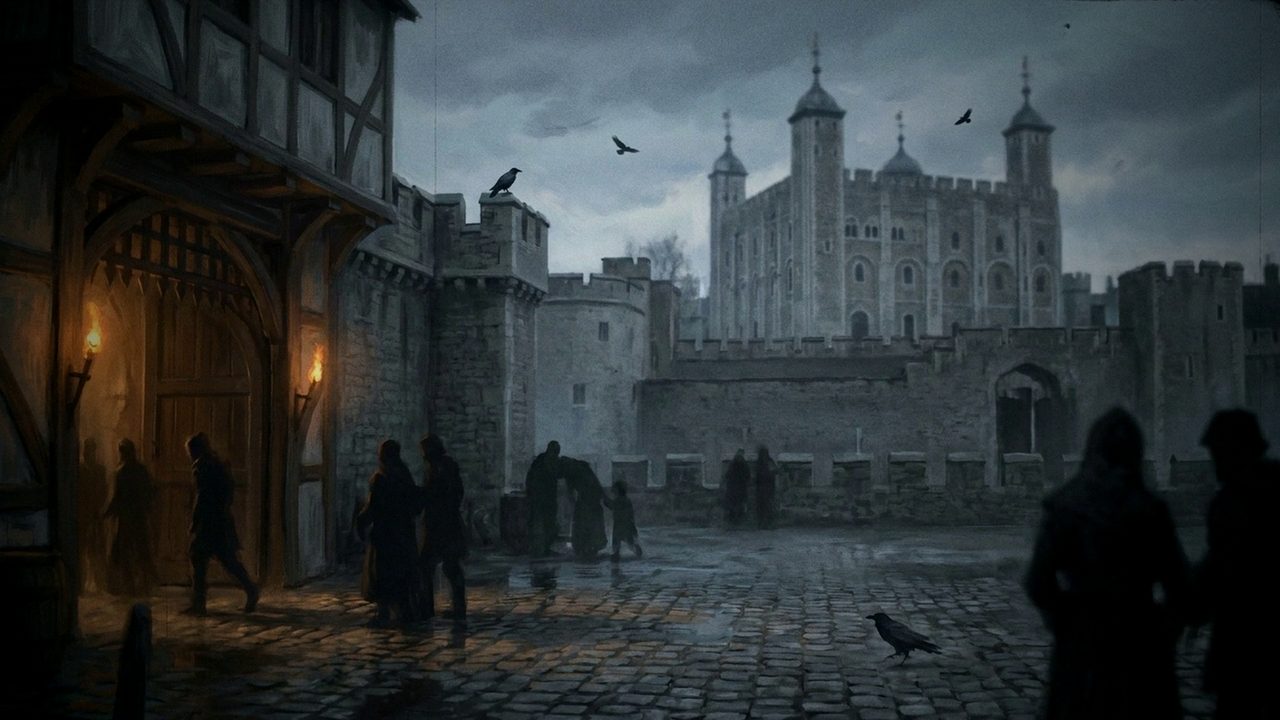
By mid-May, Edward was lodged in the Tower of London. And here I want to clear something up before it distorts the picture. In fourteen eighty-three, the Tower was not the grim relic of executions we tend to imagine. It was a royal palace — fortress yes, but the traditional residence for kings before their coronations. The boy was not, in those first weeks, being imprisoned. He was being installed where a king-to-be was supposed to be installed, while the city prepared to crown him. The coronation was set for the twenty-second of June.
Then came the part that is genuinely hard to read. The younger boy, Richard, was not in the Tower. He was with their mother, Elizabeth Woodville, who had taken him and sought sanctuary at Westminster — the ancient refuge of the church. On the sixteenth of June, the nine-year-old was, in the careful language of the records, persuaded out of sanctuary. To keep his brother company. A mother gave up her younger son so the two boys could be together. She would not see either of them again.
Now both boys were inside the same walls. And the ground shifted almost immediately. On the twenty-second of June, a sermon was preached across London — by a cleric named Ralph Shaa — declaring that the sons of Edward the Fourth were illegitimate. Not lawful heirs at all. Bastard children. With no rightful claim to anything.
That summer, the argument was given legal form in a document called Titulus Regius. It held that Edward the Fourth's marriage to the boys' mother had never been valid — that he had been pledged to another woman first, a lady named Eleanor Butler, before the wedding ever took place. If that prior pledge was real, the marriage was void. If the marriage was void, the children were illegitimate. And if the children were illegitimate — they could not be king.
The crown passed to the next man in line. The uncle. On the sixth of July, fourteen eighty-three, Richard, Duke of Gloucester, was crowned King Richard the Third of England. The Protector had become the King. The two boys who stood between him and everything he now held were inside his Tower.
What happened next is the quietest kind of horror. Through that summer and into the autumn, the boys were seen less, and less, and less. Early accounts say they were glimpsed at first playing in the garden of the Tower. Then they moved to the inner rooms. And then they moved out of the written record of the world entirely. No coronation. No funeral. No grave. No body that history has ever managed to identify with any certainty. Two children in the high summer — and gone before the leaves turned.
That is the hole at the center of this story. And for more than five hundred years, the world has filled it with a single name, spoken with absolute confidence: a twisted uncle, a monster, the most famous villain in the English language. Before we ask whether that name belongs there, we need to understand who put it there. And what they had to gain.
The Portrait and the Painter
You already know the villain of this story. You've known him, in some form, your whole life — even if you've never opened a single book about fourteen eighty-three. So let us lay the legend out clearly and honestly, because we cannot weigh truth against it until we have seen exactly what shape it takes.
The legend gives us a Richard the Third twisted in body and in soul. A hunchback. A withered arm. A limping, plotting creature who murders his way to a throne and then kills his own young nephews to keep it. That is the Richard most people carry. And he is, genuinely, one of the great characters in the English language. A character. That is the word worth sitting with.
Because the Richard you know was, in very large part, composed — built up over decades, by writers, for audiences, under a particular roof. And the roof matters enormously.
The most famous version of him stands on a stage. Around fifteen ninety-three, William Shakespeare wrote his play Richard the Third — and it is a magnificent piece of theatre. The crookbacked king, monstrous and charming at once, whispering his designs to the audience like a shared secret. But a play is a play. Shakespeare was writing more than a hundred years after the boys vanished. He was writing for a crowd, for a theatre, and for a queen. His Richard is a triumph of dramatic imagination. He is not a court transcript.
And the queen is exactly the problem. The throne of England in Shakespeare's day belonged to the Tudors. The Tudors had taken that throne from Richard the Third — by killing him in battle. A dynasty that seizes power by destroying the last king has a permanent interest in how that last king is remembered. The darker the predecessor, the brighter the men who replaced him. That is not a conspiracy. It is simply how dynasties work.
Go back, then, behind the play, to the text it leaned on. The most influential early account of Richard as a murderer was written by Sir Thomas More — that same Thomas More — in his History of King Richard the Third. Notice the timing. He wrote it around fifteen thirteen to fifteen eighteen. Thirty years after the boys disappeared. Thirty years on, under the Tudors, by a man who had been a child when it happened. More's account is vivid, and detailed, and damning. It is also late, secondhand, and written inside the regime that had every possible reason to want Richard found guilty. Polydore Vergil told the same story, in the same years, for the same patrons. And from those roots, the portrait set hard — like wax cooling around a stamp. The monster. The smothered children. The certainty.
And then, in two thousand twelve, the ground literally gave something back. Richard the Third's own skeleton was found beneath a car park in the city of Leicester. In twenty thirteen, DNA confirmed the identification beyond doubt. And the bones could be read like a final witness.
The hunchback was a lie. Richard did have a curved spine — scoliosis — which would have made one shoulder noticeably higher than the other. But there was no hump. No withered arm. No lurching, monstrous frame. The single most famous physical detail in the entire legend — the very emblem of his supposed inner corruption — was an invention, elaborated by writers and hardened into fact by a stage. If the legend was that wrong about his body, what confidence should we have that it is right about his soul?
So here is where this chapter sets us down. The man the world was taught to convict was painted by his enemies, decades after the fact, for an audience that needed him guilty. And we have now caught that painting in at least one plain, measurable lie. Which forces the deeper question. If this is what the winners wrote — what did the people who were actually standing in fourteen eighty-three have to say? The answer is stranger than the legend, and far quieter. What they said, mostly, was that they did not know.
The Voices Left Standing
Put the monster aside for a moment. Let us go back to fourteen eighty-three itself — to the sources that were written while the boys were still fresh in the world's memory — and ask not how frightening the story is, but what the witnesses actually knew. Because the closer you get to the event itself, the less certainty there is. The closer you look, the more you see people confessing their own ignorance.
Our clearest witness was a stranger. An Italian named Dominic Mancini was in London in fourteen eighty-three, and set down what he saw and heard before the year was out. He is invaluable precisely because he was an outsider — no Tudor patron to flatter, no English faction to serve. He was simply watching a city in the middle of something terrible, and writing it down.
What Mancini describes is dread — not proof. He records the boys growing less visible by the week, retreating first from the garden, then from the windows, then from any account at all. He says the elder boy, the young king, carried himself like someone being prepared for death. He reports that rumour had spread through London: that the children might already have come to harm. And then Mancini does the most important thing any source in this file does. He says he does not know. He writes, plainly, that he was unable to discover whether the boys had been killed, or in what manner — only that they had vanished, and that the city was afraid.
Sit with that. Our single best contemporary witness — the man closest in time, with the least motive to lie — gives us the fear. He does not give us the crime. The evidence he offers is a rumour, not a verdict. And he is honest enough to say so.
The other near-contemporary voice tells the same shape of story. The Croyland Chronicle, written around fourteen eighty-six by someone close to the royal court, also speaks of rumour and spreading fear. And it too stops short of naming anyone. Suspicion. Unease. A city that feared the worst. And, from the people actually present — no definitive answer at all.
This is the fracture at the heart of the famous story. The certainty did not come from the witnesses. The witnesses were not certain. The certainty came later — from Thomas More, thirty years on, and from the stage, a century on — and from a dynasty that had every reason to need an answer. The people who lived through it admitted they did not know. The people who came after, who had not been there, were the ones who were absolutely sure.
And the confession everyone half-remembers? There is a story that a man named Sir James Tyrell later confessed to the murders — that he arranged them, on Richard's orders. But look closely, and it dissolves in your hand. It surfaces in Tudor sources, years after the fact — not as a signed, documented, contemporary admission that anyone could question or test. It arrives conveniently late, in the possession of people who needed it to be true. It may be genuine. It may be a tidy ending sewn on after the fact, when no one was left to contradict it. We cannot stand on it.
So strip the whole thing back to what is genuinely beyond dispute. Both boys were alive and in the Tower in the summer of fourteen eighty-three. After that summer, they vanish from the record. Whether they died, and how, and when, and at whose hand — or whether both of them died at all — is not, in the honest sense of the word, known. Everything else is theory. And the theories do point in a direction — but not as cleanly, and not with anything close to the confidence the legend offers for free.
Because here is the turn the famous story never lets you hear. There is more than one suspect. And there is a serious case — argued in our own century — that the door of the Tower was never, in fact, the door of a tomb. That one of those boys may have walked back out into the world.
Bones, Pretenders, and a Door Left Ajar
Two years after the boys vanished, the man at the centre of it all met his own ending. On the twenty-second of August, fourteen eighty-five, King Richard the Third was killed in battle at Bosworth. The crown passed to the man who defeated him: Henry Tudor, crowned Henry the Seventh. The dynasty that would shape Richard's memory for the next five centuries had arrived.
And then something happened that the simple version of this story struggles to account for. Young men began to appear — claiming to be one of the lost princes. If everyone knew the boys were dead, if the matter was settled, why did anyone take them seriously?
The first was a boy named Lambert Simnel, put forward in fourteen eighty-seven. But the one who genuinely shook a kingdom was Perkin Warbeck. From around fourteen ninety-one, Warbeck claimed to be the younger prince — Richard, Duke of York — grown to manhood, escaped, and returning to claim what was his. He was not laughed out of every room. He was backed by foreign courts. He raised real support. Serious people in serious positions treated him as a serious threat — for nearly a decade. Henry the Seventh had him executed in fourteen ninety-nine.
The careful historian's view — and probably the correct one — is that Warbeck was an imposter. But hold the strangeness of it. If the boys' deaths were settled, public, and certain, a man claiming to be one of them should have been obviously fraudulent from his first word. Instead, the question stayed open enough that foreign kings and English nobles thought it worth backing. The uncertainty we feel now, looking back over five centuries — they felt it then, standing in the room.
And then — the bones. In sixteen seventy-four, nearly two hundred years after the boys disappeared, workmen at the Tower of London uncovered a wooden box beneath a staircase. Inside were the skeletons of two children. King Charles the Second declared them the lost princes, and had them interred with honour in a marble urn in Westminster Abbey, where they remain to this day.
It would be such a satisfying ending. But it is not a satisfying ending at all. Those bones have never been proved to be the princes. They were examined once, in nineteen thirty-three, by the standards of that era — which could not reliably establish even the sex of the children, let alone the year or cause of death. A modern DNA analysis — the one test that might answer the question — has, so far, not been permitted. The urn in the Abbey carries a label that history has never been able to verify.
Which brings us to the most provocative idea in this file. In twenty twenty-three, the researcher Philippa Langley — whose earlier work had helped recover Richard's skeleton from that Leicester car park — published the findings of a long investigation she called the Missing Princes Project. Her argument is arresting. That the princes, or at least one of them, were not murdered. That they may have been spirited away. That the so-called pretenders were not frauds but the genuine article.
I want to be honest with you about where that idea stands. It is a minority view. Many serious historians — Michael Hicks prominent among them, writing in twenty twenty-four — push back firmly. The case, they argue, is circular: a code-name or a claim is not the same thing as proof, and the plainest reading of the silence remains that the boys died. I will not sell the survival theory as an established answer. But I will not quietly bury it either. Because it is a real, argued, twenty-first-century attempt to answer a question the legend pretends was always closed. And the honest truth is — that door was never firmly shut.
The Verdict
The last pages of this file were never written. Before the theories: one thing owed to two children. These are not crimes to be entertained. They are competing explanations for the disappearance of two real boys — and not one of them carries the weight of a courtroom. No one standing in these pages was ever tried. I will name no one as a murderer by fact. I will only tell you which way the evidence leans, and how far.
Theory one: that Richard the Third had the boys killed — 50%
The traditional answer, and still the majority view. For it: he had the most powerful motive of anyone alive — two living nephews were a permanent, inextinguishable claim on his throne. He had them in his custody. The rumours of their deaths were circulating in fourteen eighty-three, while he still reigned — not retrospectively invented. Against it: there is no confession from the time, no body that has ever been securely identified, and the most damning accounts are all Tudor, and all written a generation or more after the fact.
Theory two: that one or both boys survived — 20%
The Missing Princes case, published by Philippa Langley in twenty twenty-three. For it: the pretenders were taken seriously by serious powers, the case draws on documents traced across Europe, and the deaths were never, strictly speaking, established. Against it: the historical mainstream rejects it, arguing that a code-name is not a proof, and that most scholars still read the silence as a grave. I hold this one higher than its odds might suggest — not because it is likely, but because it is the one serious modern challenge to a story everyone assumed was permanently closed.
Theory three: that Henry Stafford, Duke of Buckingham, was behind it — 12%
For it: he was among the most powerful men in England that summer, with direct access to the Tower, with considerable ambitions of his own, and a distant claim to the throne in the background. He turned against Richard and rebelled that very autumn — and was executed for it. Against it: the case is entirely circumstantial. Opportunity is not evidence.
Theory four: that one or both boys died of natural illness — 10%
For it: Mancini noted that the elder boy appeared unwell, and a quiet death from sickness would explain the missing funeral just as readily as a murder would. Against it: for both children to die naturally, so close together in time, at precisely the most convenient moment for their uncle — that is a great deal to ask of coincidence.
Theory five: that Henry the Seventh himself was responsible — 8%
For it: once he held the throne, the York boys were a direct threat to him. And one of his earliest acts was to overturn the law that had declared them illegitimate — quietly restoring them, in legal terms, to the status of rightful heirs. Against it: the chronology is fatal to it. The boys vanished in fourteen eighty-three — two full years before Henry Tudor held a day's power in England.
Lay the cards down. Fifty to Richard. Twenty to survival. Twelve to Buckingham. Ten to illness. Eight to Henry. And not one of them reaches the certainty the legend has handed out for five hundred years, free of charge.
If you ask me, the ledger leans toward the uncle. The strongest motive. The keys to the door. The rumours already rising while he was still alive to hear them. If I had to write a name down, it would be his. But I would write it in pencil. Not in ink. Because the loudest, most settled version of this story was not written by anyone who witnessed it. It was written by the side that won the war, for the audience the war produced.
Two names remain, that the legend so often forgets to say, under all those crowns and daggers: Edward, who was king for a season and never wore the crown. And Richard, nine years old, coaxed out of his mother's arms so that his brother wouldn't be alone. Whatever took them, it took two children. And that, in the end, is the only fact every version of the story has ever agreed on.